Mobile scaffold towers: technology, use and selection at a glance
For many jobs at height, the mobile scaffold tower is the first choice — because it can be erected, moved and dismantled quickly. Depending on the project, however, there are clear limits: heavy loads, outdoor terrain, wet floors or very large working heights call for other solutions. This guide explains what a mobile scaffold tower can do, where it reaches its limits and which alternatives are regularly the better choice in professional use.
What is a mobile scaffold tower?
A mobile scaffold tower — also called a mobile access tower or rolling scaffold — is a mobile working scaffold made of aluminium or steel frames that moves on swivel castors. It is assembled without tools from standard frames, decks and diagonal braces and can be extended in height in sections.
The basic principle: fit the frames, hook in the deck, lock the castors, start work. Indoors on level floors this is practical. The decisive difference from a powered aerial work platform lies in how it moves: the mobile scaffold tower is pushed by hand — without a motor, without hydraulics, without carrying people while moving.
Distinction: a mobile scaffold tower is not lifting equipment within the meaning of the Working Conditions Decree, Chapter 7 (work equipment). People may only use the erected tower when it is stationary and locked — never while it is being moved.
Designs and types
Narrow mobile scaffold tower (0.75 m frame width)
The classic model for narrow corridors, stairwells and existing buildings. The narrow base allows use in areas that wider equipment cannot reach. Because of the small footprint, the maximum build height is limited — with a narrow frame, the limit is reached at around 5–6 m working height.
Wide mobile scaffold tower (1.35 m frame width)
More stability, larger platform area, higher permissible working heights of up to around 12 m (with outriggers). For work in halls, indoor facade renovations and stucco work.
Stair tower / stair scaffold
Mobile scaffold tower with an integrated staircase instead of a ladder. Required for longer jobs with frequent climbing up and down — particularly relevant for work at height under the Working Conditions Decree.
Folding scaffold / folding trestle
One-person scaffold for low working heights up to approx. 3 m. Technically not a true mobile scaffold tower, but the entry point for many tradespeople.
Technical data at a glance
The relevant parameters when selecting:
-
Working height: build height + body height (approx. 1.75 m standing position). A mobile scaffold tower with 5 m platform height allows approx. 6.5–7 m working height.
-
Platform width: narrow 0.75 m, wide 1.35 m — determines permissible load and stability
-
Permissible load: 150–200 kg depending on model and manufacturer (NEN-EN 1004)
-
Maximum platform height: narrow frame up to approx. 6 m, wide frame up to approx. 10 m without outriggers
-
Weight per frame: 8–15 kg aluminium, 15–25 kg steel
-
Castor diameter: 200 mm standard; larger castors are an advantage on uneven ground
-
Standard: NEN-EN 1004-1:2020 (mobile access towers made of prefabricated elements)
Applications and typical projects
Interior finishing and renovation
Painting, ceiling plastering, drywall work, cladding — mobile scaffold towers work well as long as the floor is level and load-bearing and the working height stays below 8–10 m. For private users and small trade businesses, the mobile scaffold tower is the standard tool in this area.
Hall maintenance and light upkeep
Checking lights, cabling work, inspecting heating and ventilation systems — typical tasks in warehouses where the ceiling height is below 8–10 m and no heavy loads are moved.
Stairwells and narrow access
Narrow mobile scaffold towers fit through standard doors (from 80 cm) and are suitable for stairwell renovations. Important: on intermediate landings, the tower must be completely dismantled and re-erected in the next section.
Limits of the mobile scaffold tower — and when an aerial work platform is better
A mobile scaffold tower costs erection and dismantling time. Every change of position means unlocking, moving and locking again — with frequently changing positions this quickly adds up to hours. On top of that come legal limits:
-
Outdoor terrain and unpaved ground: castors on gravel, sand or wet concrete are not permitted. The tower must stand on firm, level ground.
-
Working heights above 10–12 m: from here, the effort for mobile scaffold towers becomes disproportionate — both in erection and in stability. Special high scaffolds are expensive and complex.
-
Carrying people while moving: prohibited. Anyone working on the tower must not be moved with it.
-
Heavy loads on the platform: loads above 200 kg exceed the range of all standard mobile scaffold towers.
In these cases, a powered aerial work platform — mast lift or scissor lift — is the safer, faster and more economical solution.
Alternative to the mobile scaffold tower: rent a mast lift or scissor lift
For professional use in halls, on construction sites and for maintenance work, the powered aerial work platform beats the mobile scaffold tower on three points: speed, load capacity and safety.
Mast lift — the slim alternative up to 13 m
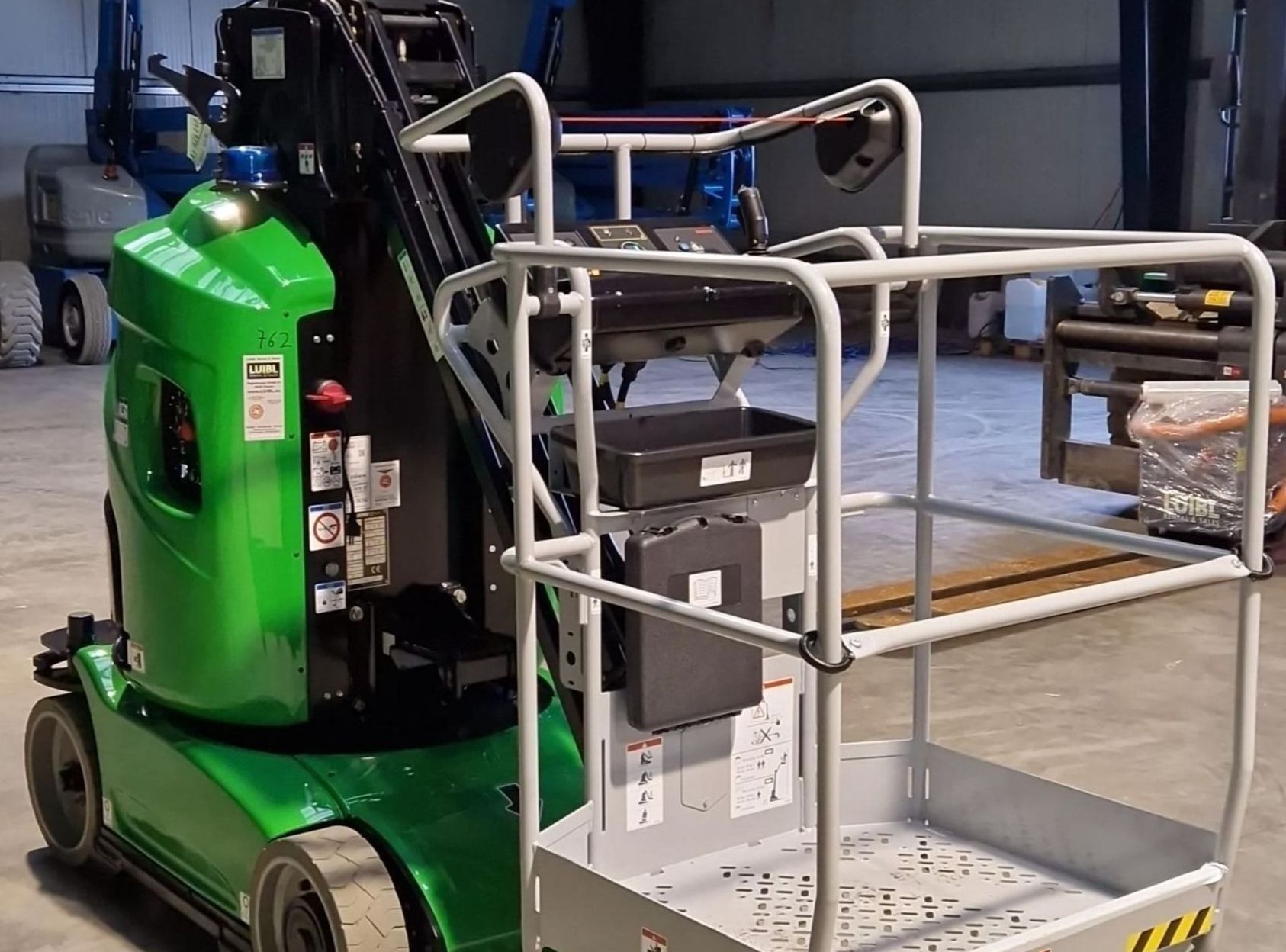
The telescopic mast lift runs electrically, with no local emissions and low noise. It fits through standard doors, leaves no marks on sensitive floors thanks to non-marking tyres and drives itself to the next position — without breaks for erection and dismantling.
Key figures of the mast lifts in the Luibl rental fleet:
-
Working heights up to 13 m
-
Load capacity up to 200 kg
-
Electric drive, non-marking tyres
-
Brands: Haulotte (Star 6, Star 10), JLG (Toucan 12E Plus), Manitou
-
Can be used indoors and outdoors
Anyone planning a mobile scaffold tower with 7 m working height for hall maintenance gets an alternative with a mast lift that costs no set-up time, is safer to operate and is collected again at the end of the day faster than a scaffold can be dismantled.
Electric scissor lift — large platform, high load capacity
When several people work on the platform at the same time or materials need to be lifted, the scissor lift is the tool of choice. Luibl rents electric scissor lifts with:
-
Working heights from 6.30 m to 33 m
-
Load capacity up to 1,000 kg
-
Non-marking tyres for sensitive industrial floors
-
Battery power — no exhaust fumes, no generator needed
For the mobile scaffold tower with 5 m working height planned for a painting or stucco job, a compact electric scissor lift is the professional alternative: set up faster, larger working area, no risk of falling during erection.
Erecting a mobile scaffold tower — what you need to watch out for
Anyone erecting a mobile scaffold tower is responsible for its stability. The key points under NEN-EN 1004 and the rules for work at height under the Working Conditions Decree:
-
Check the ground: level, firm, load-bearing — no unevenness of more than 1 cm under the castors
-
Lock the castors before stepping onto the tower — all four
-
Observe the manufacturer's maximum platform height
-
Fit the edge protection completely (guardrail, mid-rail, toe board)
-
Outriggers required for narrow frames from a certain build height (manufacturer's specification)
-
Do not place ladders on the platform
-
At wind speeds above Beaufort 6 (around 12 m/s), the tower must not be used outdoors
Towers with a staircase are preferable for work above 2 m platform height with frequent climbing — for ergonomic and safety reasons.
Renting vs. buying
Buying a mobile scaffold tower pays off for:
-
Permanent in-house use, always the same working height
-
Trade businesses with regular indoor work below 8 m
Renting a mobile scaffold tower makes sense for:
-
One-off projects or infrequent jobs
-
Changing working heights that require different build configurations
-
Lack of storage space
Renting a powered aerial work platform is better for:
-
Frequently changing positions (no erection/dismantling needed)
-
Working heights above 8–10 m
-
Outdoor use or uneven ground
-
Several people or heavy materials on the platform
-
Time pressure — a mast lift is repositioned in seconds, a mobile scaffold tower in minutes
FAQ
How high may a mobile scaffold tower be?
That depends on the frame width and the manufacturer's specification. Narrow frames (0.75 m) are usually approved up to approx. 6 m platform height, wide frames (1.35 m) up to approx. 10 m. With outriggers, the limits can be raised slightly.
May I stand on a mobile scaffold tower while it is being moved?
No. Moving the tower with people on the platform is prohibited under NEN-EN 1004 and Dutch health and safety rules. The tower must be locked before anyone steps onto it.
What is the difference between a mobile scaffold tower and a mobile access tower?
Both terms refer to the same equipment. Mobile access tower is the older term used in the standards; mobile scaffold tower has become the common term in everyday use.
Do I need instruction for a mobile scaffold tower?
For commercial use, yes — under the Working Conditions Decree, Chapter 7 (work equipment), the employer must instruct employees in safe use. This does not apply to private individuals, but the manufacturer's assembly instructions must always be followed.
Up to what working height is a small mobile scaffold tower still practical?
For working heights up to 5–6 m, a narrow-frame mobile scaffold tower is practical. From 7–8 m it pays to rent a mast lift — because of set-up time, stability and safety requirements.
Rent aerial work platforms as an alternative to mobile scaffold towers
Luibl Rental rents mast lifts and electric scissor lifts throughout the Netherlands — as a direct replacement for mobile scaffold towers where powered lifting is faster, safer and more economical. All machines are delivered inspected, with non-marking tyres for sensitive floors and, on request, with a briefing by a Luibl technician.
→ Rent a mast lift — electric, up to 13 m working height, Haulotte / JLG / Manitou
→ Rent a scissor lift — 6.30 m to 34 m, electric and diesel, load capacity up to 1,000 kg
→ Contact and quote request