Pallet stacker rental – efficient warehouse logistics in the tightest spaces
Electric pallet stacker rental: 1 to 2 t load capacity, lift height over 5 m, Li-ion battery. Delivery throughout the Netherlands. Request a quote.
Pallet stacker rental – efficient warehouse logistics in the tightest spaces
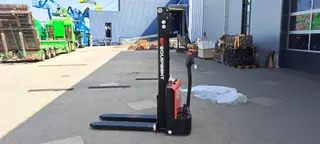
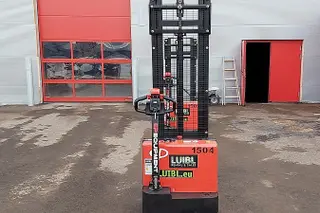
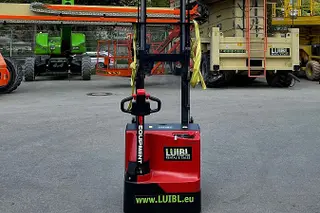
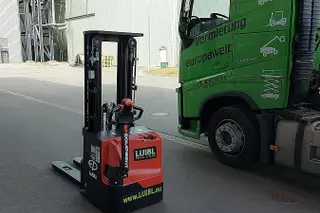
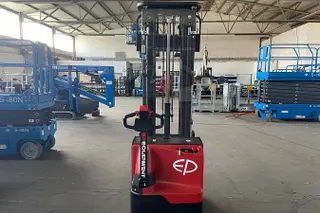
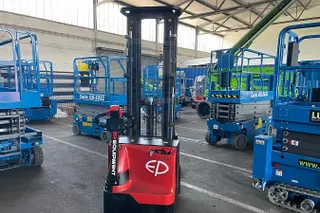
Narrow aisles, low hall ceilings, emission-sensitive indoor areas: this is where a pallet stacker is used when a conventional forklift would be too big or too loud. At Luibl you rent electric pallet stackers with lithium-ion batteries, load capacities from 1,000 to 2,000 kg and lift heights from 3 to over 5 metres. Delivered throughout the Netherlands and Europe by our own low-loader fleet.
Why rent an electric pallet stacker?
The pallet stacker closes the gap between the simple pallet truck (purely horizontal transport) and the conventional electric forklift. It lifts loads up to mast height – without local emissions, agile and with significantly less space requirement than a ride-on forklift.
The concrete advantages for warehousing and logistics:
-
Indoor operation without local emissions: the electric drive with LiFePO4 technology works without exhaust fumes – a must in food logistics, pharmaceutical production, retail and enclosed halls without powerful ventilation.
-
Manoeuvrability in narrow aisles: the compact dimensions allow work in racking aisles where a ride-on forklift has no room to manoeuvre. Decisive in high-bay warehouses and with dense block stacking.
-
Low noise level: the electric drive is quiet. This makes the pallet stacker suitable for retail areas during opening hours, residential areas for night deliveries or hospital logistics.
-
No forklift licence in the classic sense, but instruction: for pedestrian-controlled trucks such as the pallet stacker, the employer must also ensure the demonstrable competence of the operator, for example through documented in-house instruction. Full forklift training is not required in every case – more on this below.
-
Quick availability for peak loads: rental absorbs seasonal peaks. Christmas trade in retail, stocktaking, production changeovers or short-term logistics projects – the rental fleet delivers at short notice.
Choosing a pallet stacker is usually a decision against the space requirement and emissions of a ride-on forklift – while offering a higher lift than a pallet truck.
Our rental fleet: pallet stackers for every requirement
Luibl offers electric pallet stackers with load capacities from 1,000 kg to 2,000 kg and lift heights from 3 to over 5 metres. The focus is on modern machines with lithium-ion batteries – replacing older lead-acid batteries with their long charging times and the maintenance of water-cooled cells.
Standard pallet stacker for classic pallet handling
For level hall floors and typical pallet logistics (Euro pallets, mesh boxes), the standard pallet stacker is the first choice. Load capacity 1,000 to 1,600 kg, lift height 3 to 3.5 metres. It is operated via the tiller – ergonomically shaped, with fingertip controls for lifting, lowering and direction of travel.
Typical uses: intermediate storage in production, order picking in warehouses, loading and unloading vans at load-bed height.
Pallet stacker with initial lift for loading ramps and uneven surfaces
On lorry loading ramps, at thresholds at loading doors or on slightly uneven outdoor surfaces, a standard pallet stacker is not always enough. Models with initial lift additionally raise the load rollers on the fork carriage before the mast comes into action. The pallet is thus lifted off the ground along its entire length – the machine clears thresholds and ramp edges without the load rollers touching down.
That is the decisive difference from the standard machine: where the working environment is not completely level, initial lift makes operation possible in the first place.
Electric pallet stackers up to 2 tonnes load capacity
For heavier loads and multi-shift operation, Luibl offers electric pallet stackers with up to 2,000 kg load capacity and lift heights over 5 metres. These machines work with a triplex mast and full free lift – important in halls with limited ceiling height. The lithium-ion battery allows opportunity charging during breaks; the machine stays ready for shift operation without a battery change.
An example model from the rental fleet is the EP ES series – Li-ion based, with an integrated charger and designed for continuous use in intralogistics.
Technical criteria: choosing the right walk-behind stacker
Four parameters determine which model suits your application.
Load capacity and load centre: the rated load capacity always applies to a defined load centre – usually 500 or 600 mm. With longer or asymmetrical loads, the residual load capacity decreases. The load chart on the machine shows the exact values for each lift height and load centre position. Particularly relevant: at maximum lift height, the permissible load falls well below the rated value – an aspect the operator must take into account when storing goods high in racking.
Lift height and mast type: three designs are common on the market. Simplex (single mast) allows lift heights up to approx. 3 m without telescoping. Duplex (two-part telescopic mast, partly with free lift) reaches 3.5 to 4.5 m. Triplex (three-part mast with full free lift) lifts to over 5 m – with the same retracted height. Free lift is the distance the fork carriage can travel upwards without the mast itself extending – decisive in halls with low doors or ceiling beams.
Retracted height: often forgotten, but it determines whether the machine fits through doors and under ceiling beams. With duplex and triplex masts with free lift, the retracted height remains manageable even at high lift heights. Before renting: measure the door height at the site.
Turning circle and aisle width: pallet stackers are guided by the operator on foot (pedestrian-controlled). The turning circle is well below that of a ride-on forklift – allowing aisles from around 2.2 m wide. For even narrower aisles there are narrow-aisle versions of the three-way stacker type, available from Luibl on request.
Battery and charging: lithium-ion batteries are standard at Luibl. Advantages: opportunity charging without loss of capacity, no gassing (no separate charging room needed), longer service life than lead-acid. The integrated charger works with 230 V mains power – no high-voltage installation required. Depending on use, a full charge lasts a full shift; opportunity charging during breaks extends operating time considerably.
Applications: from retail to industry
-
Retail and DIY stores: shelf filling during opening hours, quiet and without local emissions. Pallet stackers with initial lift clear door thresholds between storeroom and sales floor.
-
Food and beverage logistics: HACCP-compliant indoor logistics with fully electric machines. No diesel forklift permitted.
-
Pharmaceutical and clean-room logistics: operation without local emissions and a low noise level are a must here.
-
Production and intermediate storage: supplying production lines, returning empty pallets, putting away and retrieving goods in the adjacent racking area.
-
Order picking and dispatch: in combination with pallet trucks, the pallet stacker forms the backbone of intralogistics in e-commerce and distribution.
-
Unloading lorries in city centres: where there is no room to manoeuvre a ride-on forklift, the pallet stacker unloads directly from the lorry into the shop – a classic application in the city centres of Amsterdam or Utrecht, and equally in the historic centre of The Hague.
FAQ: pallet stacker rental

What is the difference between a pallet truck and a high-lift stacker?
How long does the battery of an electric high-lift pallet truck last in use?
What is the stowed height of the stacker when retracted?
What insurance do I need for a rented high-lift pallet truck?
Is a forklift certificate required for a high-lift stacker?
Full-service rental at Luibl: European delivery and maintenance
Luibl operates its own low-loader fleet and delivers pallet stackers in the Netherlands, Germany, Austria, Switzerland, Poland, the Czech Republic, Italy, Hungary and other European countries. In the main economic regions (Amsterdam, Rotterdam, Utrecht, Eindhoven and surroundings), delivery takes place at short notice.
What the rental includes:
-
Periodic inspection of work equipment under the Working Conditions Decree: all machines are inspected at handover. The inspection sticker is clearly visible. For long-term rentals, Luibl renews the inspection during the ongoing rental.
-
Integrated charger: the charger is built into the vehicle and works with a standard 230V socket. No special installation required at the site.
-
Handover report: written documentation of the machine's condition at delivery and return – protects both parties in the event of damage.
-
Technical service on request: in the event of technical faults or operating questions, a service technician is dispatched promptly. Included in the service contract for long-term rentals.
-
Young rental fleet: the machines are usually less than 3 to 5 years old. This means up-to-date technology (LiFePO4 battery, ergonomic tiller, modern safety features) and a low failure rate.
Request a no-obligation rental quote for pallet stackers now
Which model suits your application – standard or initial lift, 1 t or 2 t class, simplex or triplex mast – depends on four factors: load capacity, required lift height, overall height at the site and ground conditions. A consultation with Luibl clarifies these points in a few minutes and brings the right machine to your site.
Contact:
-
Phone: 00800 2000 3000 (toll-free) or +49 (0) 851 756868-0
-
Email: [email protected]
-
Online enquiry: www.luibl.eu/kontakt/