Telehandler rental: fixed, roto, heavy-duty and electric models from Manitou, Merlo, Magni and Genie. Delivery throughout the Netherlands. Request a quote.
Telehandler rental - from fixed and roto to heavy-duty telehandlers
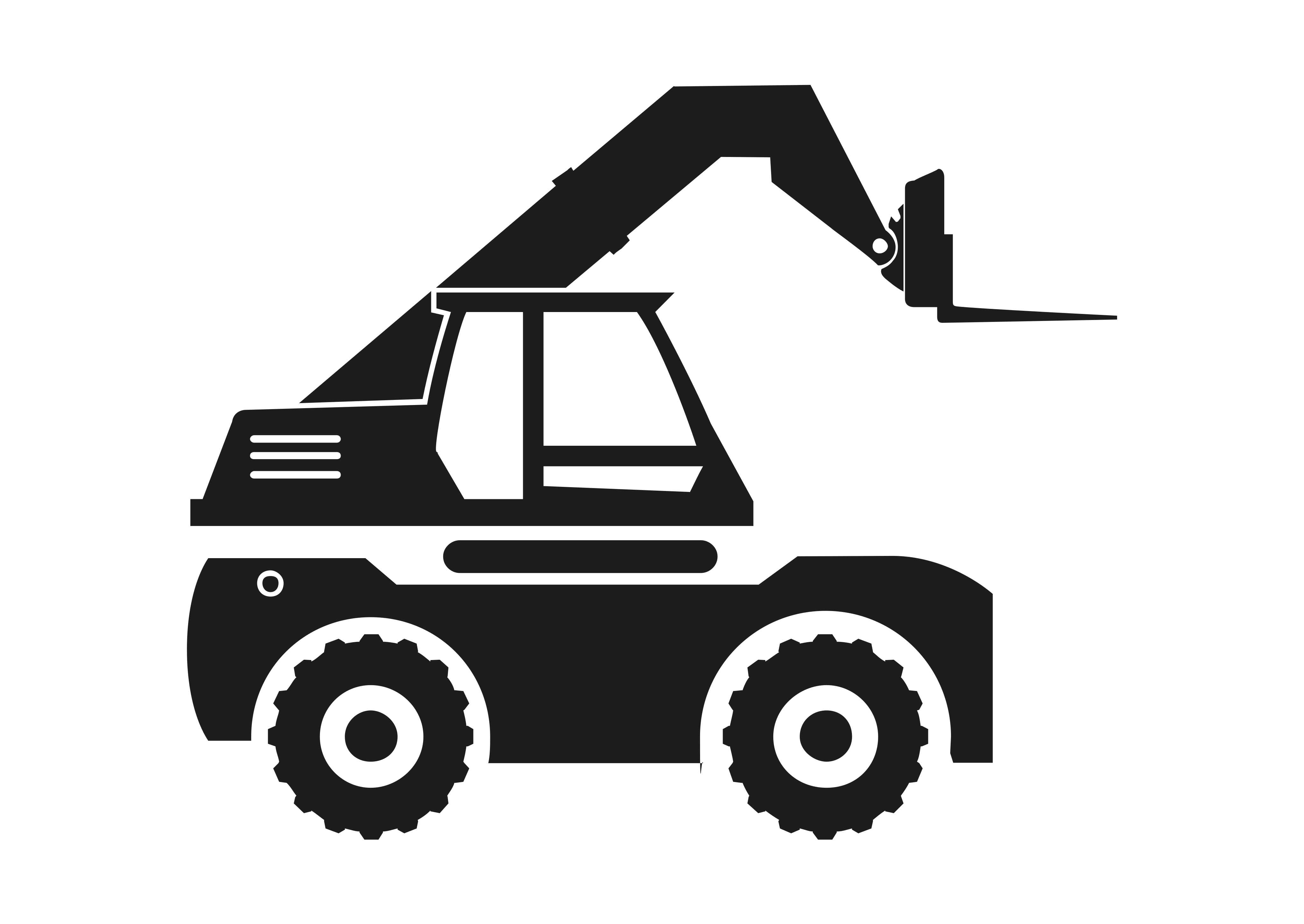
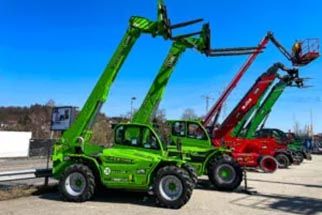
Telehandlers - depending on the industry also called telescopic forklifts, teleloaders or telescopic handlers - are among the most versatile machines on modern construction sites: they lift pallets to great heights, feed material into narrow installation openings and move loads laterally far beyond the chassis. A distinction is made between fixed machines and roto telehandlers, whose upper structure rotates through 360 degrees. Which telehandler is the right choice for your project depends on three factors: lift height, load capacity and the required slewing radius.
Fixed, roto or heavy-duty: which telehandler fits?
The first step in choosing a machine is distinguishing between the three main types. Each configuration is optimised for specific tasks - the wrong choice costs time and money.
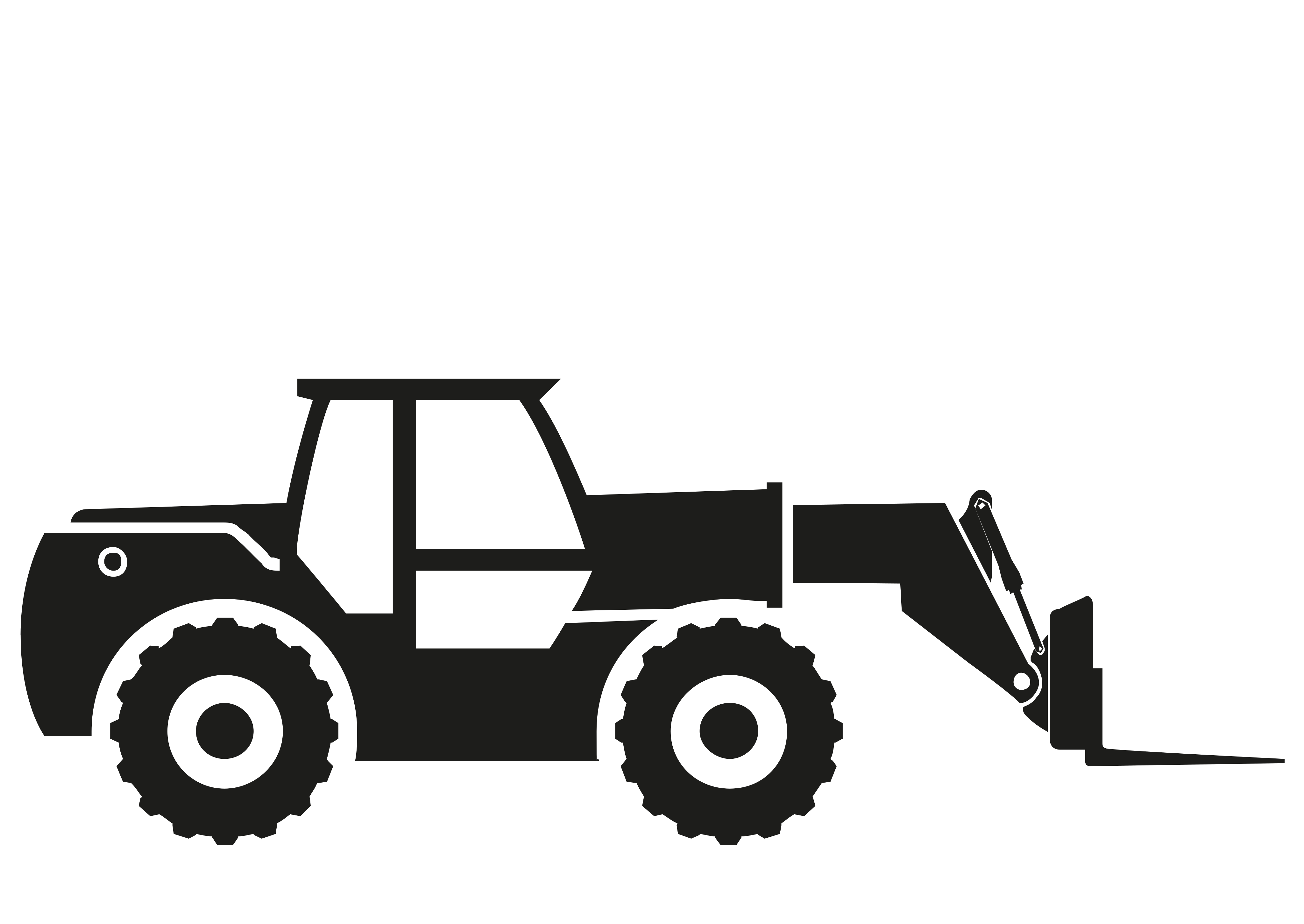
Fixed telehandlers - compact and proven on site
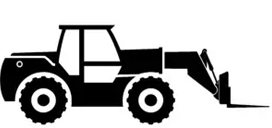
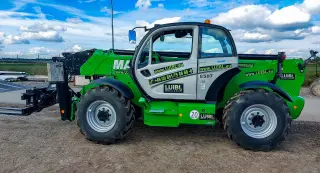
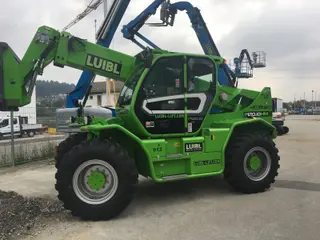
Fixed telehandlers are the most widely used machines in building construction and civil engineering. The boom extends straight out; loads are moved in line with the vehicle axis. Typical loads: 2.5t to 10t. Lift heights: 6m to 18m.
Typical applications:
- Lifting pallets and building materials to intermediate floors (shell construction, building construction)
- Supply and removal at roof and facade areas
- Material transport on cramped industrial and commercial sites
- Indoor use with limited ceiling height
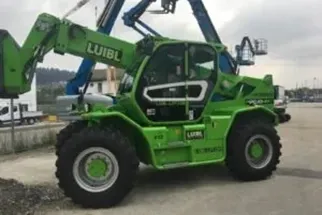
Luibl Rental offers fixed telehandlers from Manitou (MT series, ULM series), Merlo (P series) and Genie (GTH series) - from 2.5t load capacity and from 6m lift height upwards.
Roto telehandlers - 360-degree rotation for confined conditions
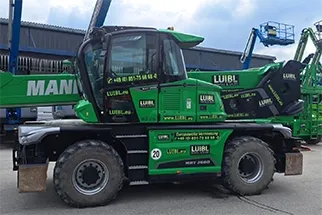
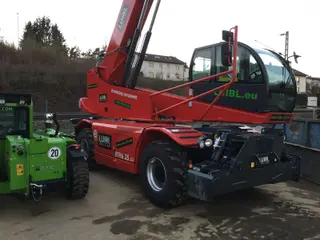
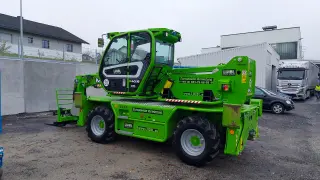
The roto telehandler rotates its upper structure through a full 360 degrees. This enables working positions that fixed models cannot reach: placing material behind obstacles, working in several directions from one position and reducing the set-up area to a minimum.
Typical applications:
- Steel construction: lifting beams and trusses into place
- Roof work and facade installation with lateral reach
- Installation work in halls with several transfer points
- Special jobs requiring 360-degree rotation in tight spaces
Luibl Rental offers roto telehandlers from Manitou (MRT series), Merlo (Roto series) and Magni (RTH series) with lift heights from 16m to 35m and load capacities from 4t to 7t.
Heavy-duty telehandlers - up to 33t for industry and manufacturing
Heavy-duty telehandlers are designed for loads that exceed the capabilities of conventional models. With capacities from 10t to 33t, they are used in plant engineering, manufacturing and the energy sector - wherever a crane is not possible or not economically viable.
Luibl Rental offers heavy-duty telehandlers from Manitou (MHT series) and Merlo (P series heavy-duty) with a maximum load capacity of 33t (Manitou MHT 12330).
Four questions to find the right telehandler
The types differ less in appearance than in their operating profile. These four questions reliably narrow down the choice:
-
Do you lift straight ahead in the direction of travel? Then the fixed telehandler is the simpler and more economical machine - the most widely used type in construction.
-
Do you need to work in several directions from a fixed position? The roto telehandler rotates its upper structure through a full 360 degrees. This pays off when material is placed behind obstacles or the set-up area is limited.
-
How heavy is the load? Above the usual construction classes, the heavy-duty telehandler takes over - industry and plant engineering, ports and handling, wherever a mobile crane would be technically possible but uneconomical.
-
Do you work in enclosed halls? Then the electric telehandler is the right choice: no local emissions and low noise, with no exhaust extraction needed inside the building.
Regardless of the design, the attachment determines the actual benefit – pallet forks, bucket, work platform, load hook or winch change the load chart and the reach. So tell us the purpose of the job, not just the preferred model.
Telehandler designs compared
The following overview summarises the four designs in the rental fleet. The decisive factors for the selection are always lift height, load capacity at the required outreach and the available space for setting up the machine.
| Design | Load capacity | Lift height | Rotates 360° | Typical use |
|---|---|---|---|---|
| Fixed | 2.5–10 t | 6–18 m | no | Shell construction, building construction, material supply on open ground |
| Roto | 4–8 t | 16–39 m | yes | Steel construction, roof and facade installation, confined set-up areas |
| Heavy-duty | 10–33 t | 9–16 m | no | Plant construction, manufacturing, energy sector, crane replacement |
| Electric | up to 2.5 t | up to 6 m | no | Indoor use, emission-free interiors, night work |
The three key questions:
- How high does the load need to go? Up to 18 m a fixed telehandler is sufficient. Above that there is no way around the roto.
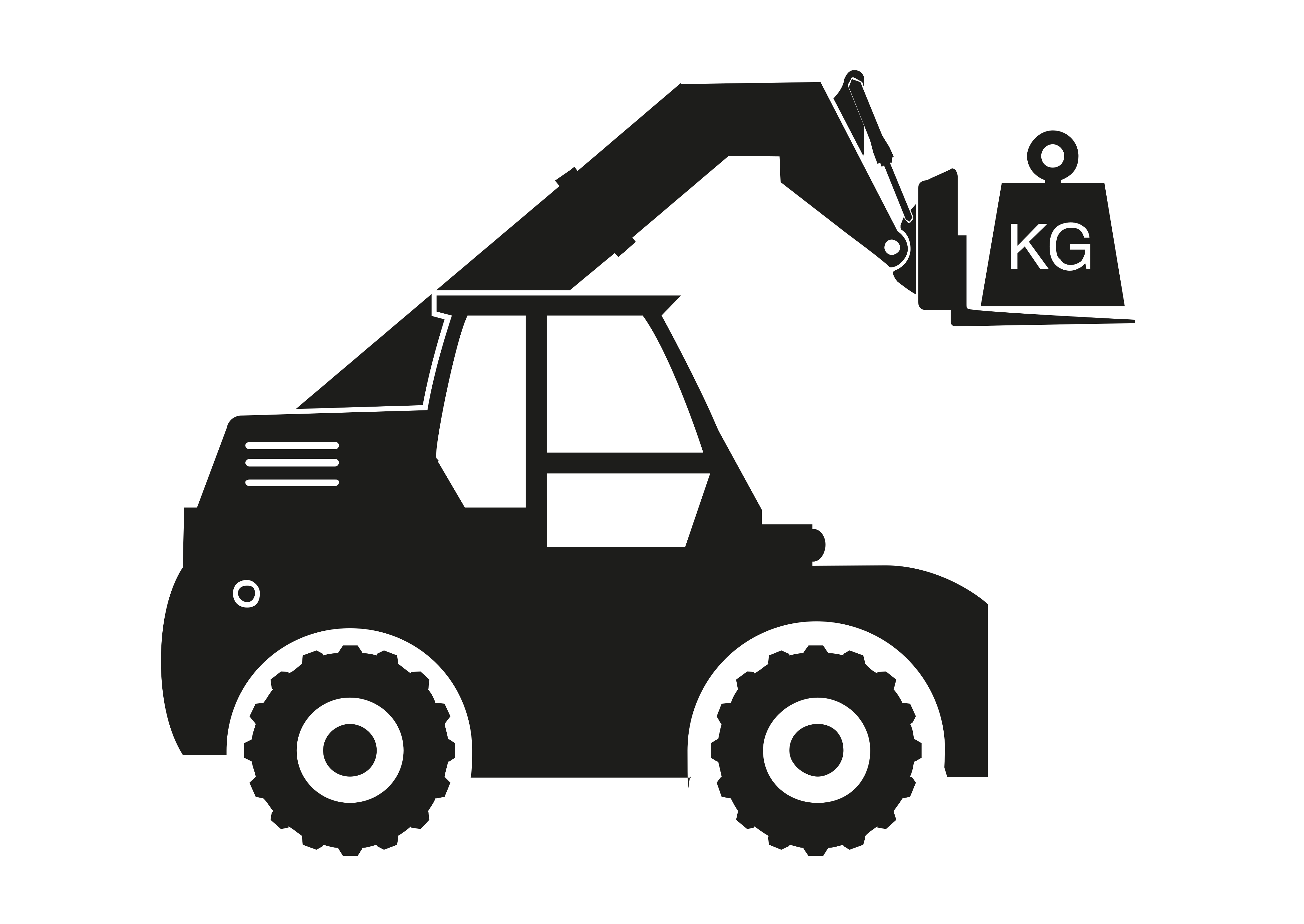
- How heavy is the load — and at what outreach? The rated load capacity only applies with the boom retracted. At full reach, depending on the model, only a fraction of it remains; the load chart of the specific machine is always decisive.
- How much space is available for setting up? If the machine has to be repositioned for every drop-off point, the 360° superstructure of the roto saves more time than the extra cost.
If you cannot decide between two classes, tell us the lift height, weight, outreach and ground conditions — we will propose the right machine.
Applications and industries
Construction: Building construction and turnkey construction, civil engineering, road construction — the telehandler handles supply, installation and horizontal transport in one.
Industry and manufacturing: Plant construction, machine installation, moving heavy tools — heavy-duty models with up to 33 t where there is no space for a crane.
Event technology: Stage construction, tent structures, temporary hall structures — roto telehandlers for confined event areas with several set-down points.
Agriculture: Silage work, harvest campaigns, livestock building construction — fixed telehandlers as seasonal reinforcement without tying up capital.
Energy sector: Maintenance and installation work on wind turbines, photovoltaic systems and substations.
Attachments for telehandlers
A telehandler only becomes a universal machine with the right attachment. All attachments are delivered together with the machine on request and are already matched to the respective machine type — the mounting and the load charts must match the machine, otherwise the use is not permitted.
Pallet forks — the standard for material handling: pallets, big bags with spreader beam, formwork elements, insulation packs. Usually already fitted to the machine unless otherwise agreed.
Work platform (man basket) — turns the telehandler into an aerial work platform for installation, maintenance and inspection work. When using a man basket, the requirements for work at height under the Working Conditions Decree also apply; the machine must be approved for carrying persons and equipped accordingly.
Load hook and jib — for lifting on the rope instead of on the forks: steel components, precast elements, ventilation and pipe elements. The jib extends the reach over obstacles and in many cases replaces the use of a crane.
Winch — for controlled lifting and lowering over greater distances, typical for roof and facade installation and in steel construction.
Bucket — light-material and heavy-material buckets for bulk material, excavation and handling in recycling and agriculture.
Which attachments are available for which machine is shown in the overview of telehandler attachments. Attachments are priced separately from the machine rate — so they should always be included in the description of the application when you send an enquiry.
Delivery with our own low-loader fleet
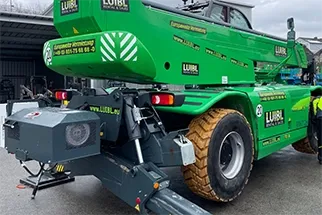
Luibl Rental transports all rented telehandlers with its own low-loader fleet — without third-party hauliers, with a dedicated contact person from order to collection. Our own fleet enables plannable delivery windows and fast scheduling, even for requests at short notice. Delivery throughout the Netherlands.
Technical requirements and operator competence
The following requirements apply to operating a telehandler:
Driving licence: For use on public roads, a category B or C licence is needed, depending on the weight. Operator competence: The employer is responsible for the demonstrable competence of the operator in line with applicable Dutch health and safety rules. Use with man basket: When using a work platform, the requirements for work at height under the Working Conditions Decree also apply. Operating manual: Every rented machine is provided with an up-to-date operating manual and a handover report.
How much does it cost to rent a telehandler?
There is no generally valid price list for telehandler rental – design, class and duration of use vary too much. However, the calculation always follows the same factors:
- Design: Fixed telehandlers form the entry class. Roto machines with a 360° superstructure are above that, heavy-duty telehandlers with load capacities of more than 30 tonnes form the top.
- Lift height and load capacity: Within each design, the rate increases with lift height and load capacity. A 6 m machine and a 30 m machine are several classes apart.
- Rental period: Daily, weekly and monthly rates are staggered. The longer the term, the lower the calculated daily rate; from several months, long-term rental conditions apply.
- Attachments: Work platform, load hook, bucket, pallet forks or winch are priced separately and are one of the most common reasons why two quotes do not seem comparable at first glance.
- Transport: Delivery and collection by low-loader to your site are shown separately and depend on the location, transport weight and access to the site.
The rate includes a technically maintained machine with valid inspection, maintenance and periodic inspections during the rental period, as well as technical advice on choosing the machine. If you state the lift height, load capacity, required attachments, rental period and location, you will receive an itemised quote instead of a price range.
Rental terms at a glance
Minimum rental period: Billing is based on a daily, weekly or monthly rate; from several months, long-term rental conditions apply.
Included in the rental rate: a technically maintained machine with valid inspection, maintenance and periodic inspections throughout the entire rental period, as well as technical advice on choosing the machine.
Delivery and collection: delivered by low-loader to your site, throughout the Netherlands. The costs depend on the location, transport weight and access to the site and are shown separately in the quote.
Return: The machine is taken back in the condition in which it was handed over. Handover and return are documented in a report.
Briefing: The operator receives a briefing from us on site at handover.
Our team will answer questions about a specific situation directly — go to contact.
Guides on the telehandler
- Which telehandler suits my application? – fixed, roto or heavy-duty
- Renting a telehandler: the costs – price factors in detail
- Competence of the telehandler operator – what applicable Dutch health and safety rules require
- Telehandler or wheel loader? – the machine comparison
- Telehandlers in halls – ceiling height, exhaust gases, floor loading
Telehandler rental in your region
We deliver by low-loader to your site, throughout the Netherlands. You will find dedicated pages for these cities:
Amsterdam · Rotterdam · The Hague · Utrecht · Eindhoven · Groningen · Tilburg · Breda · Nijmegen · The whole of the Netherlands
You will find the entire equipment range across all categories in our rental fleet.
FAQ: telehandler rental at Luibl Rental

Which brands are available in the rental fleet?
How soon is a machine available?
What qualification does the driver need?
What happens if a machine breaks down during the rental period?
What is included in the rental price?
What load capacities are possible with heavy-duty telehandlers?
Is there a price list for telehandler rental?
Which attachments can I rent with the telehandler?
When is a roto telehandler worthwhile compared with a fixed telehandler?
What is the difference between a telehandler and a telescopic forklift?
From what rental period is long-term rental worthwhile?
How is the machine transported to the site?
Request a telehandler now – quote at short notice
Describe your application with details of the required lift height, load capacity, desired rental period and delivery location – we will prepare a binding quote for you at short notice, including transport costs by low-loader to your site. ➡ Send a rental request | ➡ Explore the entire rental fleet
Luibl Rental – your partner for telehandler rental in the Netherlands. Delivery throughout the Netherlands with our own low-loader fleet. Manitou, Merlo, Magni, Genie.