Truck-mounted or trailer-mounted platform rental: which suits your job?
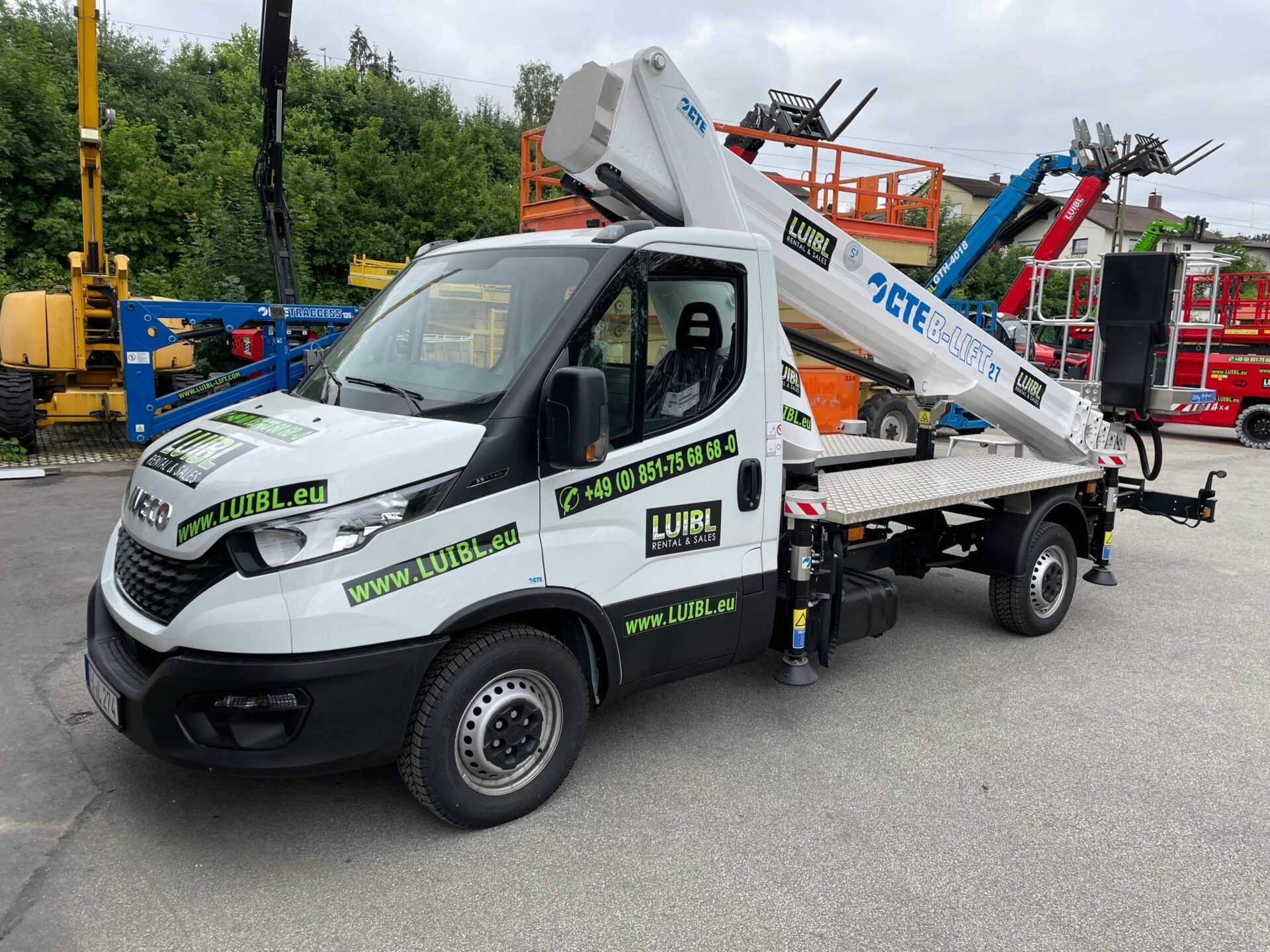
Anyone looking to rent an aerial work platform first thinks of working height and price. But another question is at least as important: how does the machine get to the site, and how quickly is it ready for use there? Truck-mounted platforms and trailer-mounted platforms solve the same basic problem in two fundamentally different ways. Which option is the better choice in your specific case depends on factors that are often overlooked in consultations.
This article explains both machine types in technical and factual terms, names their real strengths and shows when each solution makes sense.
Truck-mounted platform: mobility as a system
A truck-mounted platform is not an attachment but a fully integrated system of transport vehicle and aerial work platform. The decisive difference from a scissor lift delivered for stationary use or from transporting an articulating boom lift is that the vehicle itself carries and positions the platform. As soon as the truck is parked, set-up begins, and it often takes only a few minutes.
Technical classification
In the Luibl rental fleet, truck-mounted platforms are available in two classes:
- Class up to 3.5 t: can be driven with a category B licence, from 20 m working height, small turning circle
- Large machines up to 57 m working height: for facade work, tree care along main roads, municipal services; Ruthmann and Palfinger brands, all machines periodically inspected under the Working Conditions Decree
The hydraulic outriggers are deployed automatically. This means no manual alignment, no levelling with wedges, no loss of time. If you are working on three single-family homes in one street, you move the truck, set the outriggers, extend the platform and you are done. The time advantage on mobile sites is real and measurable.
Typical applications
- Tree care and green maintenance along roads and paths
- Maintenance and cleaning of street lighting and traffic signs
- Facade painting and plastering across several properties
- Roof edge inspection and lightning protection work on industrial estates
- Municipal services with changing locations
Trailer-mounted platform: the case against dead weight
The trailer-mounted platform has a structural advantage over the truck-mounted platform: the towing vehicle remains free. If you park the platform on a site in the morning and then organise materials with your car or van, you have no dead downtime due to a tied-up truck.
Technical classification
Trailer-mounted platforms are transported using a car tow hitch. Their decisive parameter is not the working height but the weight. Typical machines range from under 750 kg (towable without a BE licence) to approx. 3,500 kg. The low dead weight protects sensitive surfaces: driveways, lawns, paving slabs. Many models have an electric mover that allows precise manoeuvring in confined spaces without a towing vehicle.
Typical applications
- Facade work on individual properties with sensitive outdoor areas
- Gutter cleaning and minor plumbing work
- Maintenance work in courtyards and narrow access areas
- Trade businesses that use their towing vehicle as a material transporter at the same time
- Jobs on unpaved or sensitive ground (garden, green space, historic paving)
Practical example: painting company in a residential estate
A painting company has been commissioned to paint seven single-family homes on a new housing estate within two weeks. All properties are within a radius of 800 metres. The company drives a van every day carrying paint, scaffolding material and tools.
Scenario A: truck-mounted platform
The truck is at the first house at 7 a.m. Set-up time: under 10 minutes. After completing the work, stowing, moving and setting up again: approx. 15 minutes per change. Over seven properties, this adds up to around 90 minutes of logistics. The van operates independently. The conclusion: high mobility, little time lost, clear separation of access at height and material transport.
Scenario B: trailer-mounted platform
The trailer-mounted platform is unhitched in the morning and remains at the property during the day. The van is free to transport materials. Advantage: if a property is worked on over several days, there are no changeover costs. Disadvantage: with properties changing daily, the platform has to be collected, transported and set down every morning; this takes time if no second driver is available.
The result:
With rapidly changing locations and sufficient vehicle crew, the truck-mounted platform is ahead. If a property is worked on over several days and the van is more important as a material transporter than the flexibility of the platform, the trailer-mounted platform wins.
Safety: what applies to both machine types
Whether you rent a truck-mounted platform or a trailer-mounted platform, both machines are subject to the same legal requirements. All rental machines from the Luibl fleet undergo periodic inspection of work equipment under the Working Conditions Decree; the carrier vehicle or trailer also complies with Dutch road traffic rules. Planning and use are also based on EN 280 (design calculations for mobile aerial work platforms).
For operators: persons who operate aerial work platforms must have demonstrably received instruction or training, in line with applicable Dutch health and safety rules. The internationally recognised PAL Card (IPAF) is now the standard for many clients and operators.
The most important operational safety points include:
- PPE: in the basket, wearing a harness and clipping on to the designated anchor point, even for short jobs
- Wind load: from force 6 (approx. 12 m/s), most platforms must be taken out of service; the manufacturer's operating manuals define the exact limits for each model
- Ground: check the bearing capacity of the ground before use, especially with trailer-mounted platforms on private property
- Danger zones: keep a sufficient distance from overhead power lines in line with applicable Dutch health and safety rules (greater distance for medium and high voltage than for low voltage)
Which platform suits your job? We will advise you.
The choice between a truck-mounted and a trailer-mounted platform is not just a question of budget, but of logistics, ground conditions, operator structure and project duration. If you choose the wrong machine, you pay twice: once for the rental and once for the lost time. Luibl gives you specific advice, not based on a price list but on your job profile. We find the right machine, coordinate delivery throughout the Netherlands and are on hand to answer questions during the rental. Luibl GmbH Regensburger Strasse 61, 94036 Passau Toll-free: 00800 2000 3000 Phone DE: +49 (0) 851 756868-0 Mon–Fri, 08:00–17:00 Contact and enquiry: