The new NEN-EN 280: relevant changes for users of aerial work platforms
NEN-EN 280 is the European design and safety standard for mobile aerial work platforms. Anyone using aerial work platforms – owned or rented – holds a document with a direct impact on user obligations, the risk inventory and evaluation and the permitted use of machines.
In 2022 the previously single standard was split into two separate parts: NEN-EN 280-1:2022 covers calculation, stability, construction, safety and testing. NEN-EN 280-2:2022 covers additional safety requirements for load-handling devices on aerial work platforms. In addition, the draft standard prEN 280-1:2024 has been available since November 2024, bringing further clarifications – not yet adopted, but already setting the direction for manufacturers and inspection bodies.
This article explains which changes are relevant for day-to-day operation and what users need to consider when selecting and using rental machines from Luibl Rental.
New structure: from NEN-EN 280 to NEN-EN 280-1 and 280-2
The old NEN-EN 280:2016 was a single standard for all mobile aerial work platforms. The split into two parts from 2022 has practical reasons: platforms operated with load-handling devices (e.g. a basket on a telehandler or suspended loads on the boom) have different risk profiles from standard platforms without additional loads. NEN-EN 280-2:2022 addresses exactly this combination and requires additional hazard analyses, which manufacturers and users must demonstrate separately.
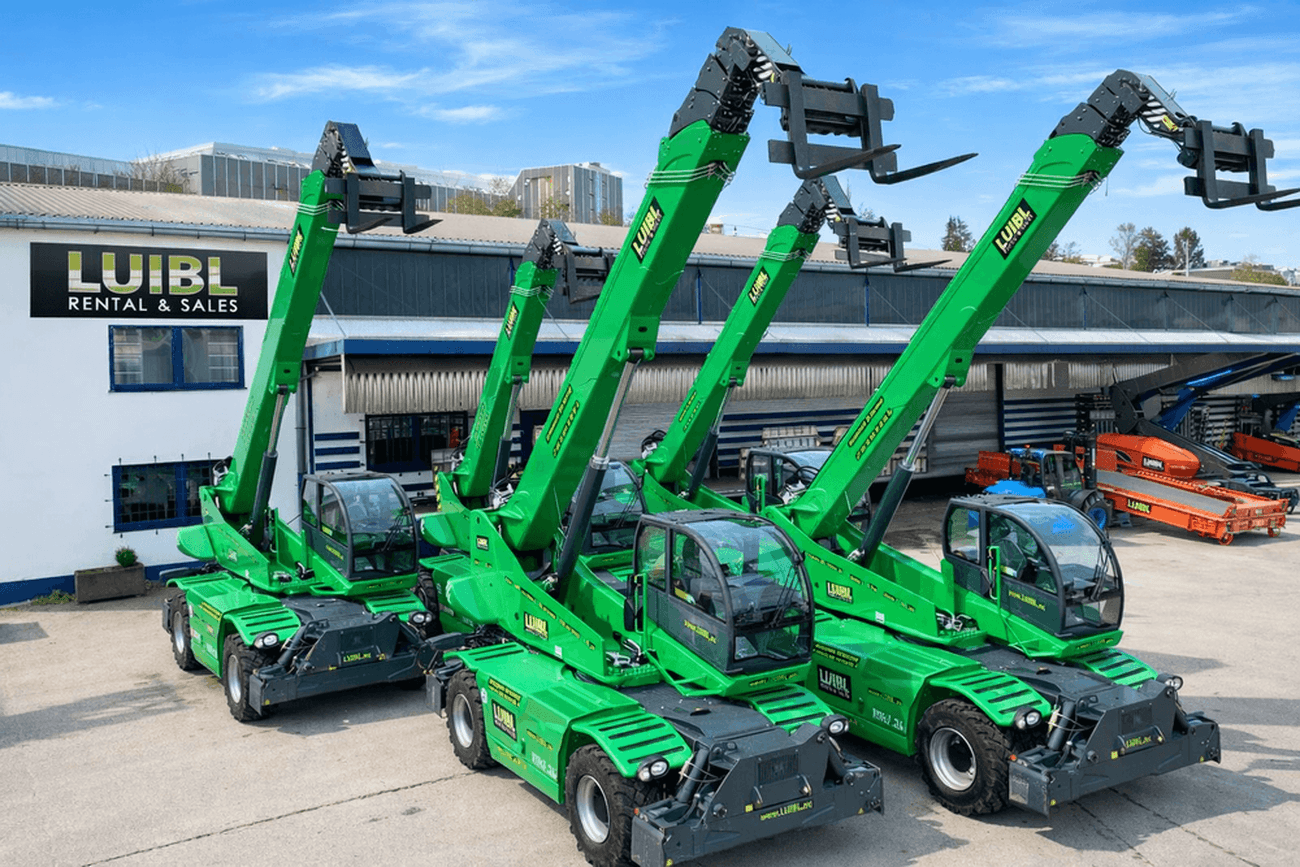
In rental practice, this means: if a roto telehandler with a personnel basket is used as an aerial work platform, not only NEN-EN 280-1 but also NEN-EN 280-2 is relevant. For all machines in this configuration, Luibl Rental provides the associated technical data sheets and load charts aligned with both parts of the standard.
Key changes in NEN-EN 280-1:2022
New and clarified definitions
Compared with the previous standard (NEN-EN 280:2016), NEN-EN 280-1:2022 introduces several new definitions of direct operational relevance:
-
Lowered travel position (new, § 3.29): For the first time, the standard defines a reference position from which driving with a raised platform is permitted under certain conditions. This is relevant for machines driven in a raised position – e.g. scissor lifts passing under obstacles.
-
Elevated travel position (new, § 3.31): Complements the lowered travel position as a defined operating state with its own safety requirements.
-
Safety function (new, § 3.30): The standard now explicitly distinguishes between safety-related and non-safety-related control functions. This affects the requirements for control electronics and fault monitoring.
-
Travelling (clarified, § 3.12): The definition has been narrowed to settle borderline cases when driving at working height unambiguously.
Stricter requirements for load sensing systems (§ 4.4.1.2)
Probably the most practically relevant change concerns the load sensing system. The requirements have been specified in considerably more detail than in the 2016 version. Modern aerial work platforms must continuously measure the actual basket load and compare it with the permissible load moment – taking into account the current outreach, the angle of inclination and the operating state (travelling vs. lifting).
Simple cut-off mechanisms that only react when the rated load is exceeded no longer fully meet the new requirements. The standard calls for dynamic load moment control that evaluates several parameters at once. Machines in the Luibl Rental fleet registered after 2022 are equipped with suitable systems.
Driving in an elevated position: group A and B (§ 4.6.9)
Clause 4.6.9 has been completely reworded to clearly separate the different requirements for machine group A (travel only permitted in the lowered position) and group B (travel in the elevated position permitted under defined conditions).
This is relevant for users because the permitted travel behaviour of a machine must now be read unambiguously from the type plate and the operating manual. Anyone driving a group A scissor lift in an elevated position is in breach of the standard – regardless of whether a technical interlock prevents it or not.
Obstacle tests (§ 5.1.4.2.2.2)
The requirements for obstacle tests (anti-crush tests) have been clarified. The standard requires machines to stop automatically and initiate a relieving movement if the basket or the lifting structure comes into contact with an obstacle. This is verified during type testing with defined obstacle tests. For users this means: this function must work before use and must not be deactivated – not even in confined working areas where the function is perceived as a nuisance.
NEN-EN 280-2:2022: load-handling devices on aerial work platforms
Anyone using a roto telehandler with a personnel basket as an aerial work platform operates a combination that falls under NEN-EN 280-2. The standard requires load-handling devices attached to the lifting structure or the basket to be assessed separately for compatibility with the overall system.
The document covers additional hazards that arise when loads are lifted together with the operators – a situation excluded on conventional aerial work platforms but designed in on roto telehandlers in basket mode. Users must ensure that baskets and load-handling devices meet the NEN-EN 280-2 requirements and that the manufacturer's documentation proves this.
For roto telehandlers with a basket, Luibl Rental provides the relevant conformity documents on request.
Outlook: draft standard prEN 280-1:2024
The draft prEN 280-1:2024 published in November 2024 continues the changes of the 2022 version and brings further clarifications to the clauses already revised. As it is a draft, its application is not yet mandatory – but it indicates the direction in which the standard is developing. Manufacturers already designing to prEN 280-1:2024 already comply with the expected next binding version.
Practical example: articulating boom lift for facade installation in windy conditions
A facade contractor uses two articulating boom lifts from Luibl Rental for glass installation in Passau. The basket is loaded with two fitters and tools to approx. 280 kg, and the working height is 22 metres.
The challenge: on windy working days, the operator must be able to reliably judge whether the current load combined with the wind is still within the permissible parameters. Older machines that only monitor the rated load give no differentiated feedback here.
The machines used feature dynamic load moment control in accordance with NEN-EN 280-1:2022 §4.4.1.2. The system shows the operator at the basket control panel the current load moment utilisation in real time and cuts off the lifting movement before a safety limit is exceeded. On handover of the machine, Luibl Rental demonstrates this mechanism in practice and records it in the briefing report.
Synergy: NEN-EN 280 and the periodic inspection of work equipment
NEN-EN 280 is a design standard – it is aimed primarily at manufacturers and sets out the technical requirements for the machine. The periodic inspection of work equipment under the Working Conditions Decree checks whether the machine in use still corresponds to its original condition. The two complement each other but do not replace each other.
This results in a clear chain of obligations for users:
-
When placed on the market, the machine must comply with the applicable version of NEN-EN 280 (manufacturer's obligation)
-
The user ensures that only machines with valid CE marking and an up-to-date periodic inspection are used
-
The risk inventory and evaluation on site must take the machine parameters into account (rated load, wind class, travel group)
-
Operators receive a machine-specific briefing that explicitly addresses the safety-related functions under NEN-EN 280-1
Every machine Luibl Rental delivers bears the CE marking and a valid inspection sticker. For questions about the conformity of specific models, Luibl Rental provides the manufacturer's documentation on request.
What users need to do now
The changes in NEN-EN 280-1:2022 are not theoretical shifts in the standard. They define specifically which technical systems a machine must have, how these systems are to be tested and which travel rules apply. Anyone operating older machines of their own built to NEN-EN 280:2016 or earlier versions must check whether the operating manual and the risk inventory and evaluation still meet current requirements.
Renting from Luibl Rental means working with machines from a well-maintained, modern rental fleet. All relevant machine data – CE documentation, load charts, inspection reports – is provided at handover.
The Luibl Rental team answers questions about the conformity of rental machines or the technical requirements for your project during service hours Mon-Fri, 08:00-17:00.
FAQ: NEN-EN 280 and user obligations
What is the difference between NEN-EN 280-1 and NEN-EN 280-2?
NEN-EN 280-1:2022 is the main standard and covers calculation, stability, construction, safety and testing of all mobile aerial work platforms. NEN-EN 280-2:2022 applies additionally to aerial work platforms fitted with load-handling devices – e.g. roto telehandlers with a personnel basket when loads are carried at the same time.
Do older aerial work platforms have to be retrofitted?
No. NEN-EN 280 is a design standard aimed at manufacturers. For users the rule is: machines must comply with the standard according to which they were built and approved. There is no obligation to retrofit existing machines. However, the risk inventory and evaluation (RI&E) must reflect the actual properties of the machine - not the requirements of a newer standard.
What do 'Group A' and 'Group B' mean for aerial work platforms?
Group A covers machines that may only be driven in the lowered travel position (stowed position). Group B covers machines that may also be driven in the raised position under defined conditions. The classification is stated on the rating plate and in the operating manual of the respective machine.
Does NEN-EN 280 also apply to rented machines?
Yes. As the user of a rental machine, you have the same obligations as with your own machines. The machine must be CE-compliant and, at the time of use, have a valid periodic inspection of work equipment under the Working Conditions Decree. Luibl Rental ensures both on handover.
What changes with the draft standard prEN 280-1:2024?
The draft continues the clarifications of the 2022 version and is not yet binding. Manufacturers designing to prEN 280-1:2024 are already prepared for the expected next ratified version. For users, nothing changes in the applicable obligations until the standard is adopted.