Hall renovation from the inside: which aerial work platform suits ceiling heights below 6 metres?
Anyone renovating an industrial hall from the inside often faces the same problem: the ceiling is too low for large aerial work platforms but too high for safe work from a ladder. Between 3 and 6 metres of room height lies a zone in which the wrong choice of machine costs valuable time – or, in the worst case, the platform simply does not fit through the door. This comparison shows which aerial work platform is right for which ceiling height.
Why the choice of aerial work platform is so decisive in hall renovations
Hall renovations cover a wide range of tasks that all have one thing in common: they take place at height. Replacing LED lighting, fitting interior insulation to roof and walls, installing or servicing ventilation systems, retrofitting sprinklers and smoke detectors – all of this requires safe access to the hall ceiling or to areas close to the ceiling.
The dilemma: standard aerial work platforms for outdoor use are often too heavy for the hall floor, too wide for narrow access points and simply too tall to fit through normal hall doors when retracted. Ladders and steps, on the other hand, are only of limited suitability as a permanent workplace for work at height under applicable Dutch health and safety rules. The solution lies in compact, electrically powered indoor aerial work platforms – but which type is right for which application?
The three decisive parameters for low ceiling heights
Before choosing a machine, three key questions must be answered:
Stowed height – will the machine even fit into the hall?
The stowed height is the most common reason for ruling a machine out. Many compact aerial work platforms have an overall height of 1.90 to 2.10 m when retracted – which is decisive for passing through hall doors (standard clear height usually 2.0–2.5 m) and for positioning under ceiling structures. Compact vertical mast lifts start at a stowed height of 1.80 m and therefore fit through many standard industrial doors.
Floor loading – can the hall floor take the weight?
Industrial halls have different floor load capacities. Warehouses are often designed for significantly lower loads than production halls. The permissible ground pressure must be checked before use. Electric scissor lifts (1,500–5,000 kg dead weight) distribute their load over the support points, whereas vertical mast lifts (700–1,500 kg) have a significantly lower floor load per contact area. If in doubt, a floor survey or the choice of the lighter machine is advisable.
Turning circle and width – can the platform reach the work?
In halls with racking, machines or narrow aisles, the vehicle width determines manoeuvrability. Models less than 0.80 m wide fit between racking rows and machine aisles. The turning circle is also decisive – vertical mast lifts score here with a very small turning radius that is unbeatable in production halls and warehouses.
Machine types compared: which suits which ceiling height?
Vertical mast lift – the most compact solution
The vertical mast lift (also vertical lift) is the first choice for ceiling heights of 3 to 8 metres. The basket rises vertically, without any lateral swing area – this minimises the footprint and allows work directly under the ceiling. Typical models such as the Haulotte Star 10 + Manitou VJR 100 are only 0.78 m wide and 2.70 m high when retracted. The electric drive produces no local emissions, and the tyres leave no marks on the hall floor.
Ideal for: LED replacement, retrofitting sprinklers, smoke detectors, cable trays – wherever individual points need to be reached quickly and precisely.
Limitation: limited platform size (usually 1 person + tools), no outreach.
Electric scissor lift – stable for long ceiling jobs
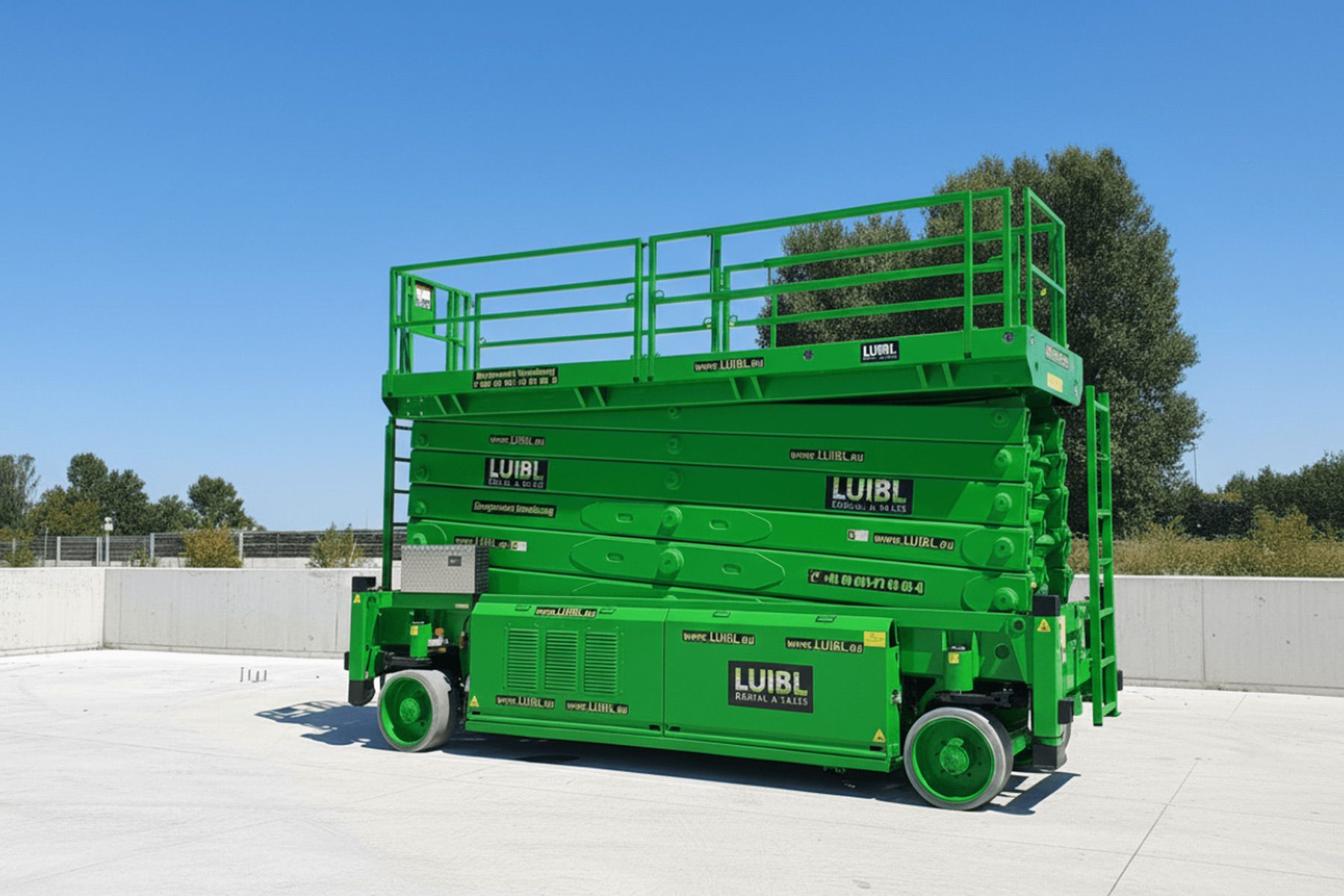
The electric scissor lift is the right choice when work is carried out over longer distances – for example when laying insulation mats, installing long ventilation ducts or fitting lighting tracks. The large platform has room for two people plus material, which saves an enormous amount of time on extensive ceiling areas.
Compact models such as the Magni ES1012AC fit through standard doors and reach working heights of 6 to 8 metres. The load capacity of up to 750 kg allows heavy components such as ventilation units or insulation boards to be carried.
Ideal for: interior insulation, ventilation installation, lighting tracks, inner facade walls – wherever work is done over large areas and with material.
Limitation: somewhat heavier than mast lifts, check the floor loading.
When things get really tight
For ceiling heights below 3.5 metres or where access is extremely restricted, the compact electric scissor lift KB Lift S-78N is often the only practical solution: narrow, manoeuvrable and with no local emissions indoors.
Ideal for: very low ceiling areas (< 3.5 m), short individual jobs, painting, plastering.
Typical applications in hall renovation
Replacing LED lighting (3–6 m): the most frequent request. Vertical mast lift or compact scissor lift. Often with stock in the basket: carry several LED fittings at once to speed up the pace.
Interior insulation of roof and walls: large-area work. A scissor lift with a large platform is recommended to carry insulation boards straight up. Scaffolding as a supplement for inaccessible corners.
Installing/servicing ventilation systems: heavy equipment, cable installation, pipe routing. Scissor lift with high load capacity. For servicing individual flaps, a vertical mast lift is often sufficient.
Retrofitting fire protection (sprinklers, smoke detectors, fire dampers): many individual points that need to be reached quickly. Vertical mast lift is ideal: small turning circle, quickly repositioned.
Comparison table: machine types at a glance
| Feature | Vertical mast lift | Electric scissor lift | Mobile scaffold tower |
|---|---|---|---|
| Stowed height | from 1.80 m | from 1.90 m | variable (assembly) |
| Width | from 0.77 m | from 0.76 m | from 0.75 m |
| Working height | 4–12 m | 6–22 m | 2–12 m |
| Load capacity | up to 200 kg | up to 750 kg | 150–200 kg |
| Dead weight | 700–1,500 kg | 1,500–5,000 kg | < 200 kg |
| Mobility | very high | medium | low |
| Drive | electric | electric | none |
| Ideal for ceiling height | 3–8 m | 5–10 m | 2.5–4 m |
| Rental cost / day | from 80 € | from 100 € | from 30 € |
Checklist: how to choose the right platform
Clarify these five points before using the machine:
-
Check the stowed dimensions – measure the clear height of the hall doors and the lowest obstacles on the route
-
Clarify the floor load capacity – obtain the hall's technical documentation or a survey report
-
Determine the working height – clear room height minus 2 m = required working height (rule of thumb)
-
Assess space requirements – aisle widths, turning circle needed, obstacles on the route?
-
Define the type of work – individual points → mast lift, area work → scissor lift, very low → mobile scaffold tower
Get advice now: our specialists will recommend the right indoor aerial work platform for your hall renovation project.
FAQ – frequently asked questions about aerial work platforms for hall renovations
Which aerial work platform fits through a standard door (2.0 m clear height)?
Compact vertical mast lifts with a stowed height from 1.80 m (e.g. Haulotte Star 10) and narrow electric scissor lifts with a stowed height of 1.90 m fit through most standard doors. Always measure the dimensions on site.
Can I use a diesel aerial work platform in the hall?
Only in exceptional cases and with adequate ventilation. For indoor use, electric aerial work platforms are the appropriate choice – no local emissions, quiet, and low-marking tyres protect the floor.
How much does it cost to rent an aerial work platform for hall renovation?
Vertical mast lifts from approx. 80 €/day, electric scissor lifts from approx. 100 €/day, mobile scaffold towers from approx. 30 €/day. Weekly rental is usually considerably cheaper than daily rental.
Does the operator need a briefing?
Yes. Operators of aerial work platforms need an instruction and must have the required competence under applicable Dutch health and safety rules; the employer must ensure this. On handover, Luibl gives an operator briefing for the rented model.
What floor load does a vertical mast lift cause?
Compact models with a dead weight of 700–1,000 kg generate 3–8 t/m² via the wheel contact area, depending on the model. The permissible ground pressure of the hall must be checked in advance.
What is the difference between a vertical mast lift and a mast lift?
The vertical mast lift rises straight up (vertical only). The articulated mast lift also has a swivelling arm and offers outreach – which makes it larger, heavier and often unsuitable for very low rooms.