Operating a wheel loader: technology, operation and driving licence at a glance
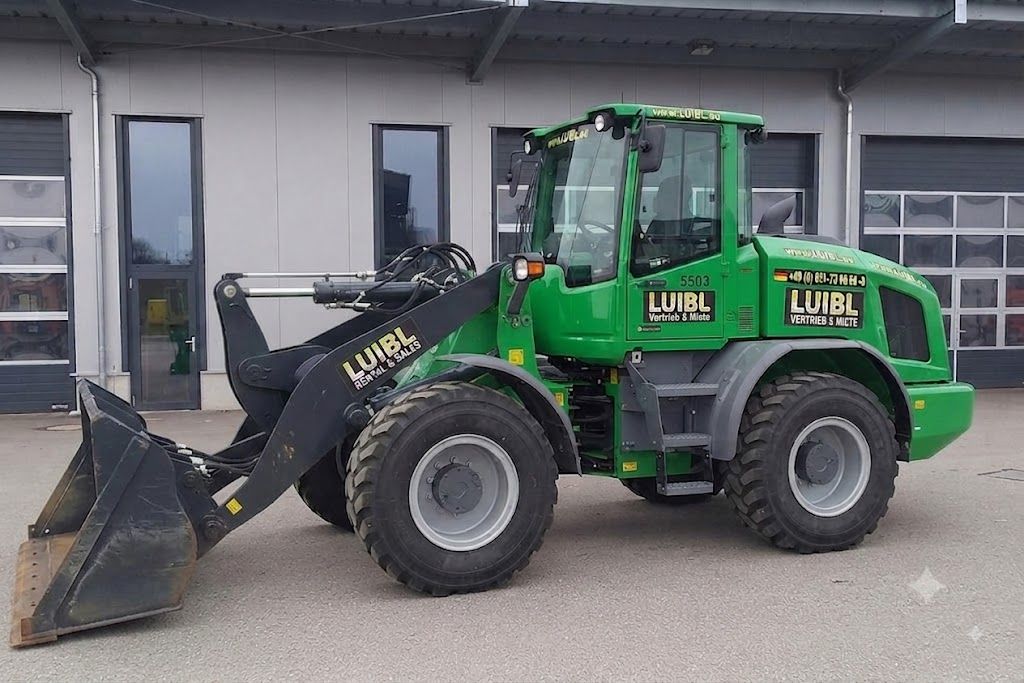
What is a wheel loader?
A wheel loader is a self-propelled construction machine with wheel drive and a front-mounted lifting device – usually fitted with a bucket. Unlike a tracked excavator, which digs, the wheel loader is designed primarily for shovelling, transporting and loading: sand, gravel, crushed stone, rubble, snow, biomass. The central design feature is articulated steering: wheel loaders do not steer via the front axle but bend the entire frame in the middle. This allows a tight turning circle despite a wide track – essential on sites, yards and material depots. Anyone experiencing this for the first time has to rethink: reversing into a space works differently than in a car.
Designs and types
Not all wheel loaders are the same. Depending on the task and site, there are clear differences:
Compact wheel loader (yard loader):
Operating weight up to about 3 tonnes, narrow, manoeuvrable, often with cab protection or roll bar. Ideal for yards, agricultural applications and tight indoor areas. The quick-change system allows attachments such as pallet forks, grabs or snow ploughs to be swapped.
Compact loader / mid-range class:
3 to 12 tonnes operating weight, the classic site wheel loader. Sufficient bucket volume for earthworks, truck loading and material transport over short distances. Luibl rents wheel loaders from this segment with various bucket capacities and load capacities.
Large wheel loader:
From about 15 tonnes upwards, for quarries, mining and bulk handling. Rare in the normal rental range – specialist rental companies or in-house fleets dominate here.
How operation works
Before moving off
The daily inspection is a must, not an option. Oil levels, hydraulic fluid, tyre pressure, lights, seat belts – all of this must be checked before every use. Anyone taking over a rental wheel loader should record its condition on handover in writing. When climbing in: consistently follow the three-point rule (two hands and one foot, or two feet and one hand). Wheel loaders have raised entries – slippery steps are a common cause of accidents.
Driving and steering:
Articulated steering responds directly. On paved ground this is no problem. On uneven terrain, on side slopes or with a heavy load in the bucket, you have to anticipate the reaction. Basic rule: always drive slowly with a raised load and take bends wide. Reversing takes practice. The articulation point is behind the operator's position – the rear swings out differently than expected in tight manoeuvres.
Bucket work:
Picking up material with the bucket follows a clear sequence: align the bucket close to the ground, push into the material while driving, raise and tilt at the same time. Too much at once costs traction and puts unnecessary strain on the drivetrain. Good operators work with small, coordinated movements – not brute force. During transport, only raise the bucket as far as necessary: 30 to 40 cm above the ground is enough for driving. Loads raised high considerably increase the centre of gravity.
Driving licence and competence: what is required?
There is often uncertainty here – the main points are clear: On public roads: wheel loaders count as motor vehicles. Anyone moving a wheel loader on public roads needs the required Dutch driving licence category or, for vehicles over 3.5 t gross vehicle weight, a C/CE licence – depending on weight and permitted maximum speed.
On company premises and sites:
No road driving licence is required, but: under applicable Dutch health and safety rules (Working Conditions Decree, Chapter 7, work equipment), operators must be sufficiently competent and instructed for the machine concerned. The employer is responsible for demonstrating and documenting this.
Wheel loader certificate / operator certificate:
There is no uniformly regulated statutory "wheel loader certificate". There are, however, recognised training courses. With such certificates, the employer can demonstrate the operator's competence.
Briefing on handover:
Luibl gives the operator a briefing on handover of a rental wheel loader. Anyone using a rental wheel loader with little experience can request this briefing from Luibl.
Insurance for a wheel loader
Anyone who buys a wheel loader must insure it like any motor vehicle:
Business liability insurance:
Covers damage that the wheel loader causes to third parties – required by law on public roads, strongly recommended on private company premises.
Machinery insurance / comprehensive cover:
Insures the machine itself against damage (tipping and fall damage, fire, theft).
Liability on sites:
Contractors' all risks (CAR) insurance often requires proof of insurance cover for the machines used.
Anyone who rents a wheel loader usually bears an excess in the event of damage. How high it is and which types of damage are covered is set out in the rental agreement. Luibl explains this transparently when the contract is concluded – ask explicitly about the liability framework for rental machines.
Applications: what is a wheel loader used for?
Wheel loaders are all-rounders. The most common commercial applications:
- Loading trucks with bulk material (sand, gravel, crushed stone, biomass)
- Material transport on sites and in quarries over short distances
- Snow clearing on logistics areas, yards and municipal roads
- Recycling and composting: picking up, moving and loading material
- Road construction: placing frost-protection material and base layers
- Yard logistics in agriculture and horticulture
Where a wheel loader reaches its limits – ground too soft, very tight access, digging work – excavators, compact loaders or telehandlers take over. On request, Luibl advises which machine suits your specific job.
Selection criteria when renting
With a rental wheel loader, three questions are decisive:
Bucket capacity and load capacity:
How much material should be picked up per work cycle? A small bucket with heavy material (crushed stone: approx. 1.7 t/m³) means many trips. A large bucket with light material (wood chips: approx. 0.25 t/m³), on the other hand, can overload the machine if the bucket is filled too full.
Attachment:
On request, Luibl offers attachments for wheel loaders – hydraulic hammer, buckets in various sizes, forks, grabs. Quick-change systems allow swapping without special tools.
Transportability:
Wheel loaders over 3.5 tonnes require transport by low-loader. Luibl delivers throughout the Netherlands by low-loader directly to your site.
Renting vs. buying
A new wheel loader of 5 to 12 tonnes costs between €80,000 and €200,000, depending on equipment and manufacturer. On top of this come insurance, periodic inspections, maintenance, wear and parking space. Anyone who does not use the machine continuously is paying for dead capital. Renting pays off for anyone who needs wheel loaders for specific projects or seasons – snow season, construction project, special order. Long-term rentals over several months are available at significantly better daily rates than short-term rentals and can include the periodic inspection and maintenance.
FAQ
Do I need a driving licence to operate a rented wheel loader?
On company premises or a fenced-off site, no road driving licence is required – but sufficient competence and instruction in line with applicable Dutch health and safety rules are needed. Luibl provides a briefing on delivery.
What is a wheel loader certificate?
There is no uniformly standardised "wheel loader certificate". In practice, the term refers to operator training by recognised providers, with which the employer can demonstrate the operator's competence.
What is the delivery time for a rental wheel loader?
Requests at short notice are generally possible. Availability and delivery time depend on the location and current utilisation. Luibl can be reached Monday to Friday from 08:00 to 17:00.
Which attachments are available for rental wheel loaders?
Hydraulic hammer, buckets of various sizes, forks and grabs – available on request. Snow ploughs can also be booked (seasonal).
How are damage claims handled for a rental machine?
Damage during the rental period is governed by the rental agreement, usually with an excess. Technical defects not caused by third parties are remedied promptly by Luibl's technician service.
Rent a wheel loader
Luibl rents wheel loaders with various bucket capacities and load capacities – including delivery to your site and operator briefing on handover. Request a quote